A casino can advertise a huge welcome bonus and a packed game lobby, but if the cashier is slow, limited, or unreliable, none of that matters much.
For most players, How Casino Payment Processing Works becomes important the moment a deposit is declined or a withdrawal sits pending for days.
That is why payment systems are one of the clearest signs of whether a casino is worth your time.
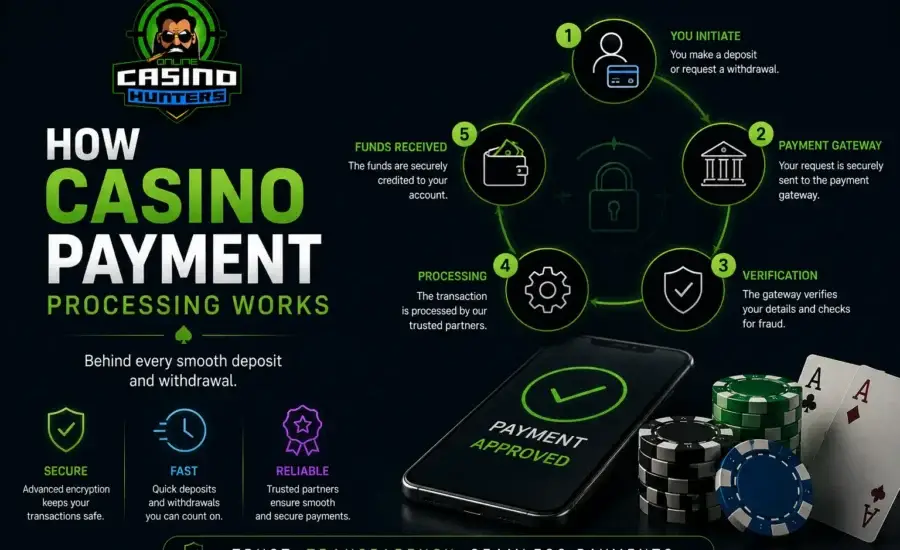
At a basic level, casino payment processing is the system that moves money between you and the operator.
That sounds simple, but several layers sit behind every deposit and withdrawal.
These include:
- The casino
- Payment processors
- Banks
- E-wallet providers
- Fraud prevention systems
- Verification checks
- Regulatory requirements
All of these can affect whether a transaction succeeds and how long it takes.
If you want to understand how casinos handle player funds overall, start with:
💳 How Casino Payment Processing Works on the Deposit Side
When you make a deposit at an online casino, the transaction usually starts inside the cashier.
You select a payment method such as:
- Visa
- Mastercard
- Bank transfer
- E-wallet
- Prepaid voucher
- Cryptocurrency
The casino then sends the payment request through a payment processor or gateway.
If you are using a card, the processor forwards the request to the issuing bank.
The bank checks:
- Available funds
- Card validity
- Risk settings
- Transaction permissions
If approved, the deposit is authorized and your casino balance is credited.
However, an instant deposit does not always mean the casino has fully received the funds.
In many cases, settlement between financial institutions happens later.
This is one reason casinos monitor:
- Account activity
- Deposit limits
- Fraud indicators
- Verification requirements
For e-wallets, the process is often faster because the wallet provider acts as an intermediary.
With cryptocurrency, the process changes again.
The casino generates a wallet address and waits for blockchain confirmations before crediting the account.
❌ How Casino Payment Processing Works: Why Some Casino Payments Are Declined
Players often assume the casino is responsible when a payment fails.
Sometimes that is true.
Often it is not.
A payment can be declined because:
- Your bank blocks gambling transactions
- The payment processor flags the activity
- Billing information does not match
- Geographic restrictions apply
- The casino is not licensed in your market
This is where payment-method transparency becomes important.
Strong casinos clearly explain which banking options work in your location.
They also separate deposit availability from withdrawal eligibility.
Not every method that accepts deposits can process withdrawals.
Casinos that support multiple payment options generally provide greater flexibility.
Examples include:
- Cards
- Bank transfers
- E-wallets
- Cryptocurrency
A broader banking setup often means fewer payment failures and better overall reliability.
💰 How Casino Payment Processing Works: Withdrawals Are Where Payment Processing Really Matters
Deposits receive attention because they are usually instant.
Withdrawals reveal whether the casino’s banking system is actually effective.
A withdrawal request rarely moves directly to your account after you click cash out.
The casino typically reviews:
- Verification status
- Bonus requirements
- Payment eligibility
- Risk indicators
- Responsible gambling flags
Only after internal approval is the payment forwarded for processing.
Timing then depends on the payment method.
E-Wallets
Often among the fastest options.
Cryptocurrency
Can be extremely fast, depending on the network and coin.
Cards
May take longer due to issuer restrictions.
Bank Transfers
Reliable but often slower than alternative methods.
This is why advertised payout speed should always be interpreted carefully.
A casino claiming 24-hour withdrawals may only mean internal approval takes 24 hours.
It does not guarantee the money arrives within that period.
For a deeper look at payout timing, see:
➡️ How to Find Fast Payouts at Online Casinos
🛡️ How Casino Payment Processing Works: The Role of KYC, AML, and Fraud Checks
If a casino asks for identification before a withdrawal, that is not random friction.
It is part of how casino payment processing works.
Most regulated casinos perform:
- KYC (Know Your Customer)
- AML (Anti-Money Laundering)
- Fraud prevention checks
These controls help prevent:
- Stolen card use
- Account takeovers
- Duplicate accounts
- Bonus abuse
- Financial crime
For players, the trade-off is straightforward.
Verification can delay a first withdrawal, but it also improves platform security.
Trusted casinos usually handle verification clearly and efficiently.
The strongest operators encourage verification before the first withdrawal request.
➡️ Casino Verification (KYC) in 2026
This is one reason fast-payout casinos stand out.
They organize verification in ways that reduce unnecessary delays.
🏦 How Casino Payment Processing Works: Payment Processors, Merchant Accounts, and Risk
Behind the scenes, casinos rarely handle card payments directly.
Instead, they work with:
- Payment processors
- Merchant account providers
- Banking partners
Online gambling is considered a higher-risk industry because of:
- Chargebacks
- Regulatory complexity
- Fraud exposure
- Geographic restrictions
That classification affects players more than many realize.
It can influence:
- Deposit success rates
- Payment method availability
- Weekend processing
- Banking reliability
Well-run casinos often maintain multiple processing partners.
This redundancy improves stability.
If one processor experiences issues, another can continue handling transactions.
For players, this often means:
✔ Fewer declines
✔ More consistent deposits
✔ Better cashier performance
🎁 How Casino Payment Processing Works: How Bonuses and Payment Rules Overlap
Payment processing is closely connected to bonus policies.
The method you use can affect:
- Bonus eligibility
- Withdrawal approval
- Verification requirements
- Risk reviews
Some casinos exclude:
- Prepaid methods
- Certain crypto transactions
- Alternative payment systems
from bonus promotions.
Others require withdrawals to follow the same route used for deposits.
This helps satisfy fraud-prevention and compliance requirements.
That is why experienced players evaluate both:
- The promotion
- The cashier
before registering.
A strong bonus means very little if payment rules create unnecessary delays.
🔍 How Casino Payment Processing Works: What to Check Before You Trust a Casino Cashier
The best way to evaluate a casino payment system is to look beyond payment logos.
What really matters is:
- Payment availability
- Withdrawal speed
- Verification requirements
- Processing reliability
- Fee structure
You should also confirm whether the same method supports both deposits and withdrawals.
Some casinos accept deposits through one method but process withdrawals through another.
This changes the payout experience significantly.
For banking comparisons, see:
➡️ Best Online Casinos by Payment Method
Practical banking details often reveal more than marketing claims.
₿ How Casino Payment Processing Works: Crypto, Cards, and E-Wallets All Have Trade-Offs
No payment method is perfect.
Cards
✔ Familiar
✔ Widely accepted
❌ More likely to be declined
E-Wallets
✔ Fast withdrawals
✔ Convenient
❌ Availability varies by market
Bank Transfers
✔ Reliable
✔ Higher limits
❌ Slower processing
Cryptocurrency
✔ Fast transactions
✔ Privacy benefits
✔ Flexible limits
❌ Network fees
❌ Wallet errors
❌ Market volatility
The best option depends on your priorities.
If speed matters most, e-wallets and crypto often lead.
If simplicity matters, cards and bank transfers remain strong choices.
🎯 How Casino Payment Processing Works: The Real Takeaway for Players
How Casino Payment Processing Works is not just a technical topic.
It directly affects:
- Deposits
- Withdrawals
- Verification
- Bonus eligibility
- Overall player experience
The strongest casinos make banking easy to understand.
They support methods appropriate for your location, explain verification clearly, and process withdrawals efficiently.
If a casino is vague about payment methods, hides withdrawal timelines, or creates confusion around verification, consider that a warning sign.
To evaluate broader trust signals, see:
➡️ What Makes a Casino Trustworthy?
🎰 Final Thoughts on How Casino Payment Processing Works
Understanding How Casino Payment Processing Works helps players make better decisions before they deposit.
The cashier experience often reveals more about a casino than its bonus promotions.
The best operators:
✔ Support multiple payment methods
✔ Process withdrawals consistently
✔ Explain verification requirements clearly
✔ Maintain transparent banking policies
When comparing casinos, give the payment section the same attention you give games and bonuses.
That is often where the difference appears between a flashy casino and one that actually pays players efficiently.
🌍 Additional Resources for Players
Understanding how casino payment processing works becomes much easier when you look at the organizations that help regulate, test, and monitor the industry.
The following resources can help players learn more about licensing, game fairness, security standards, and responsible gambling practices:
Malta Gaming Authority (MGA)
The Malta Gaming Authority is one of the most recognized gambling regulators in the industry. The MGA oversees licensed operators, enforces compliance standards, and helps ensure that casinos follow strict rules regarding player protection, security, and responsible gambling.
eCOGRA
eCOGRA is an independent testing and certification organization that audits online casinos and gaming software. Casinos certified by eCOGRA have typically undergone reviews related to fairness, player protection, and operational standards.
GamCare
GamCare is a leading responsible gambling organization that provides support, education, and resources for players who may be experiencing gambling-related problems. The organization offers practical tools, confidential advice, and information designed to encourage safer gambling habits.
While payment methods, withdrawal speeds, and banking flexibility are important when choosing a casino, responsible gambling and player protection should always remain part of the decision-making process.

Related Posts

